WORKATO · AI RESEARCH + PRODUCT MANAGEMENT + DESIGN
WORKATO · AI RESEARCH + PRODUCT MANAGEMENT + DESIGN
Designing an AI-Powered Academic Companion That Reduces Cognitive Load
Designing an AI-Powered Academic Companion That Reduces Cognitive Load
Designing an AI-Powered Academic Companion That Reduces Cognitive Load
Priorio
Priorio
Priorio
OVERVIEW
OVERVIEW
OVERVIEW
Priorio is an AI-powered academic productivity platform designed to help university students manage information overload across multiple apps and systems. Our team discovered that students currently lack a centralized system, which often leads to difficulty in prioritizing and organizing assignments, announcements, calendars, documents, and communications across several platforms. Priorio addresses this problem by centralizing academic information and leveraging AI to help students organize tasks, prioritize responsibilities, and plan their schedules more effectively.
Priorio is an AI-powered academic productivity platform designed to help university students manage information overload across multiple apps and systems. Our team discovered that students currently lack a centralized system, which often leads to difficulty in prioritizing and organizing assignments, announcements, calendars, documents, and communications across several platforms. Priorio addresses this problem by centralizing academic information and leveraging AI to help students organize tasks, prioritize responsibilities, and plan their schedules more effectively.
Priorio is an AI-powered academic productivity platform designed to help university students manage information overload across multiple apps and systems. Our team discovered that students currently lack a centralized system, which often leads to difficulty in prioritizing and organizing assignments, announcements, calendars, documents, and communications across several platforms. Priorio addresses this problem by centralizing academic information and leveraging AI to help students organize tasks, prioritize responsibilities, and plan their schedules more effectively.

ROLE
ROLE
ROLE
Project Manager, UX Designer
Project Manager, UX Designer
Project Manager, UX Designer
TEAM
TEAM
TEAM
Ben N., Jessica W., Kazuma I., Yuki Z.
Ben N., Jessica W., Kazuma I., Yuki Z.
Ben N., Jessica W., Kazuma I., Yuki Z.
DURATION
DURATION
DURATION
10 Months (2025.09- 2026.05)
10 Months (2025.09- 2026.05)
10 Months (2025.09- 2026.05)
SOFTWARE
SOFTWARE
SOFTWARE
Figma • Workato • Canvas API • Google Calendar API • Claude MCP
Figma • Workato • Canvas API • Google Calendar API • Claude MCP
Figma • Workato • Canvas API • Google Calendar API • Claude MCP
AT A GLANCE
AT A GLANCE
PROBLEM
PROBLEM
Students manage assignments in Canvas, schedules in Google Calendar, announcements through email, and personal tasks using separate productivity apps. Every additional platform increases the cognitive effort required to stay organized. Rather than helping students study more, many existing planning tools simply create another place where information must be manually entered and maintained.
Students manage assignments in Canvas, schedules in Google Calendar, announcements through email, and personal tasks using separate productivity apps. Every additional platform increases the cognitive effort required to stay organized. Rather than helping students study more, many existing planning tools simply create another place where information must be manually entered and maintained.
Students manage assignments in Canvas, schedules in Google Calendar, announcements through email, and personal tasks using separate productivity apps. Every additional platform increases the cognitive effort required to stay organized. Rather than helping students study more, many existing planning tools simply create another place where information must be manually entered and maintained.
CHALLENGE
CHALLENGE
Conduct user research, design AI-assisted planning experiences, and partner with Workato to explore workflow automation within a unified dashboard.
Conduct user research, design AI-assisted planning experiences, and partner with Workato to explore workflow automation within a unified dashboard.
Conduct user research, design AI-assisted planning experiences, and partner with Workato to explore workflow automation within a unified dashboard.
OUTCOME
OUTCOME
An AI-powered planner that centralizes coursework, schedules, announcements, and personalized study support.
A research-driven concept demonstrating how AI can reduce planning friction while keeping students in control of their decisions.
An AI-powered planner that centralizes coursework, schedules, announcements, and personalized study support.
A research-driven concept demonstrating how AI can reduce planning friction while keeping students in control of their decisions.
An AI-powered planner that centralizes coursework, schedules, announcements, and personalized study support.
A research-driven concept demonstrating how AI can reduce planning friction while keeping students in control of their decisions.
FINAL DESIGN SOLUTION
FINAL DESIGN SOLUTION
FULL DEMO
KEY RESPONSIBILITIES
The project was recognized with the Best Overall Award, reflecting the successful collaboration between the client and development team.
The project was recognized with the Best Overall Award, reflecting the successful collaboration between the client and development team.
01.
Priorio demonstrates how thoughtful AI integration can simplify complex workflows without sacrificing transparency or user agency.
Priorio demonstrates how thoughtful AI integration can simplify complex workflows without sacrificing transparency or user agency.
02.
By grounding every design decision in research and focusing AI on moments of genuine need, we created a concept that emphasizes trust, personalization, and cognitive support over novelty.
By grounding every design decision in research and focusing AI on moments of genuine need, we created a concept that emphasizes trust, personalization, and cognitive support over novelty.
03.
More importantly, the project reinforced a product philosophy that continues to guide my work:
More importantly, the project reinforced a product philosophy that continues to guide my work:
04.
The best AI experiences don't replace human decision-making—they make better decisions feel easier.
The best AI experiences don’t replace human decision-making—they make better decisions feel easier.
The best AI experiences don’t replace human decision-making—they make better decisions feel easier.
RESEARCH
04 / TECHNICAL RESEARCH
Evaluating an emerging AI tool landscape
The work was not about choosing a single model. I compared tools by the qualities that mattered in a production workflow: output quality, texture consistency, seamlessness, processing time, controllability, integration complexity, and artist usability.
The work was not about choosing a single model. I compared tools by the qualities that mattered in a production workflow: output quality, texture consistency, seamlessness, processing time, controllability, integration complexity, and artist usability.
MODELS EVALUATED
MODELS EVALUATED
Stable Diffusion XL
ControlNet · IPAdapter
Flux · LoRA workflows
Hunyuan3D · Tripo · Trellis
Sparc AI
Stable Diffusion XL
ControlNet · IPAdapter
Flux · LoRA workflows
Hunyuan3D · Tripo · Trellis
Sparc AI
Stable Diffusion XL
ControlNet · IPAdapter
Flux · LoRA workflows
Hunyuan3D · Tripo · Trellis
Sparc AI
TOOLS SELECTED FOR INTEGRATION
TOOLS SELECTED FOR INTEGRATION
ComfyUI custom nodes
Python + JavaScript
Three.js + WebGL
Gemini API · OpenAI API
ComfyUI custom nodes
Python + JavaScript
Three.js + WebGL
Gemini API · OpenAI API
ComfyUI custom nodes
Python + JavaScript
Three.js + WebGL
Gemini API · OpenAI API
INTEGRATION CRITERIA
INTEGRATION CRITERIA
Texture consistency
Seamlessness
Control + latency
Pipeline compatibility
Artist-facing clarity
Texture consistency
Seamlessness
Control + latency
Pipeline compatibility
Artist-facing clarity
Texture consistency
Seamlessness
Control + latency
Pipeline compatibility
Artist-facing clarity
KEY DECISION
Models were treated as interchangeable capabilities—not as a product strategy. The system prioritized repeatable material quality and visible controls over a single impressive output.
Models were treated as interchangeable capabilities—not as a product strategy. The system prioritized repeatable material quality and visible controls over a single impressive output.
CONTEXT
Why This Project Matters
Why This Project Matters
Academic planning has become increasingly fragmented.
Students manage assignments in Canvas, schedules in Google Calendar, announcements through email, and personal tasks using separate productivity apps. Every additional platform increases the cognitive effort required to stay organized.
Rather than helping students study more, many existing planning tools simply create another place where information must be manually entered and maintained.
Academic planning has become increasingly fragmented.
Students manage assignments in Canvas, schedules in Google Calendar, announcements through email, and personal tasks using separate productivity apps. Every additional platform increases the cognitive effort required to stay organized.
Rather than helping students study more, many existing planning tools simply create another place where information must be manually entered and maintained.
QUESTION
How might AI reduce the mental effort of managing school without taking control away from students?
How might AI reduce the mental effort of managing school without taking control away from students?
How might AI reduce the mental effort of managing school without taking control away from students?
METHODS
How might AI reduce the mental effort of managing school without taking control away from students?
How might AI reduce the mental effort of managing school without taking control away from students?
How might AI reduce the mental effort of managing school without taking control away from students?
User interviews
Competitive analysis
Journey mapping
Task flow analysis
Literature review
03 / DESIGN + DEVELOPMENT
Working across design and development
01 / WORKFLOW DESIGN
Mapped material creation steps and identified where artists repeatedly moved files, rebuilt maps, and retested the same decisions.
02 / AI TOOL DEVELOPMENT
Built custom ComfyUI nodes with Python and JavaScript, tested emerging models, and connected generation stages into a repeatable artist-facing workflow.
03 / 3D VISUALIZATION
Developed a Three.js material viewer to inspect generated maps on multiple geometries with real-time roughness, metalness, normal, lighting, and tiling controls.
04 / TESTING + TRANSFER
Evaluated failure modes, refined parameters, and created Korean-language documentation for setup, node connections, errors, and export instructions.
≈30%
reduction in repetitive manual production work—by connecting generation, texture processing, material preview, and export into a single production workflow.
reduction in repetitive manual production work—by connecting generation, texture processing, material preview, and export into a single production workflow.


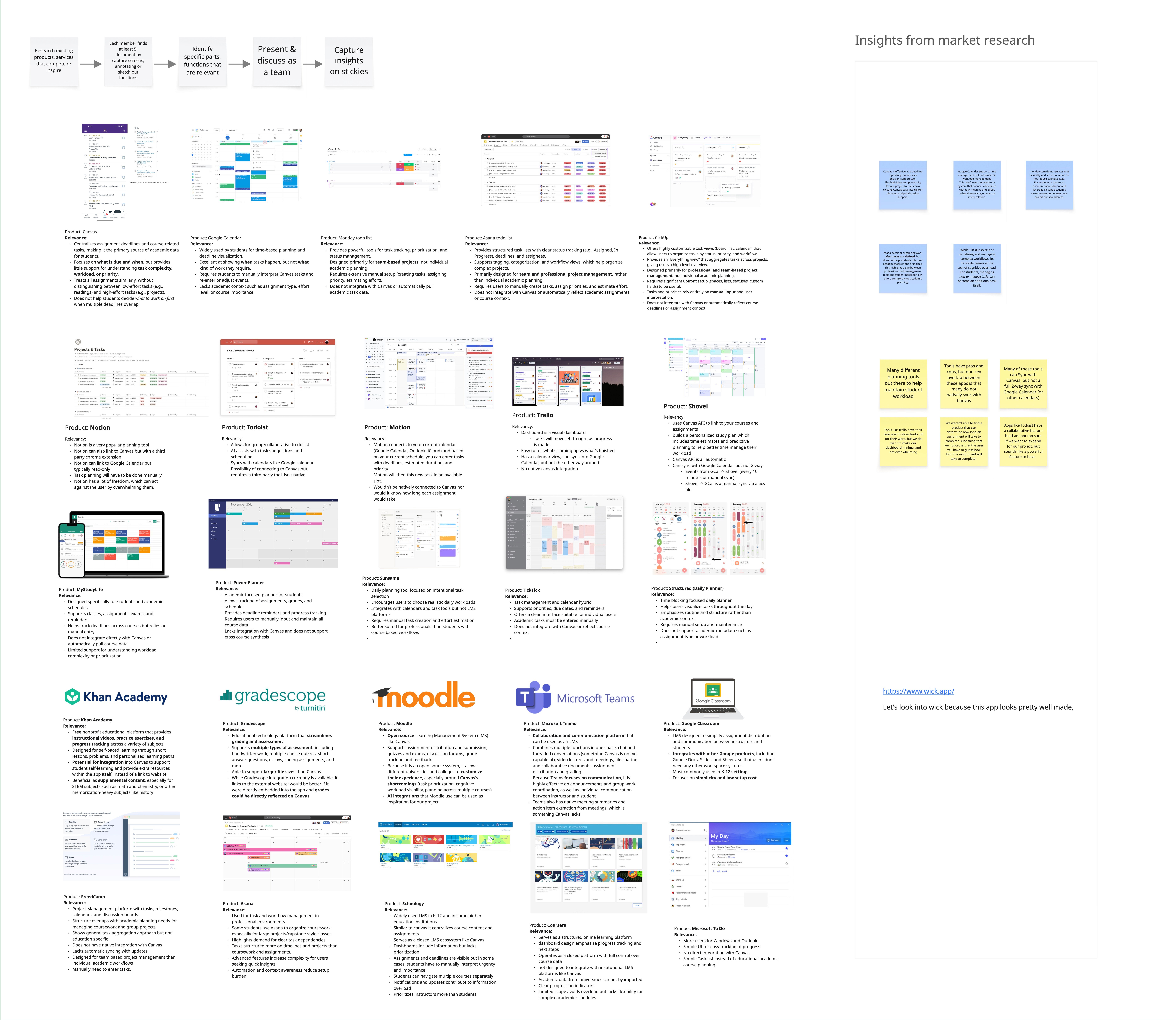
KEY FINDINGS
Why This Project Matters
Academic planning has become increasingly fragmented.
Students manage assignments in Canvas, schedules in Google Calendar, announcements through email, and personal tasks using separate productivity apps. Every additional platform increases the cognitive effort required to stay organized.
Rather than helping students study more, many existing planning tools simply create another place where information must be manually entered and maintained.
Academic planning has become increasingly fragmented.
Students manage assignments in Canvas, schedules in Google Calendar, announcements through email, and personal tasks using separate productivity apps. Every additional platform increases the cognitive effort required to stay organized.
Rather than helping students study more, many existing planning tools simply create another place where information must be manually entered and maintained.
KEY FINDINGS
Students manage assignments in Canvas, schedules in Google Calendar, announcements through email, and personal tasks using separate productivity apps. Every additional platform increases the cognitive effort required to stay organized. Rather than helping students study more, many existing planning tools simply create another place where information must be manually entered and maintained.
Students manage assignments in Canvas, schedules in Google Calendar, announcements through email, and personal tasks using separate productivity apps. Every additional platform increases the cognitive effort required to stay organized. Rather than helping students study more, many existing planning tools simply create another place where information must be manually entered and maintained.
Students manage assignments in Canvas, schedules in Google Calendar, announcements through email, and personal tasks using separate productivity apps. Every additional platform increases the cognitive effort required to stay organized. Rather than helping students study more, many existing planning tools simply create another place where information must be manually entered and maintained.
KEY FINDINGS
Students manage assignments in Canvas, schedules in Google Calendar, announcements through email, and personal tasks using separate productivity apps. Every additional platform increases the cognitive effort required to stay organized. Rather than helping students study more, many existing planning tools simply create another place where information must be manually entered and maintained.
Students manage assignments in Canvas, schedules in Google Calendar, announcements through email, and personal tasks using separate productivity apps. Every additional platform increases the cognitive effort required to stay organized. Rather than helping students study more, many existing planning tools simply create another place where information must be manually entered and maintained.
Students manage assignments in Canvas, schedules in Google Calendar, announcements through email, and personal tasks using separate productivity apps. Every additional platform increases the cognitive effort required to stay organized. Rather than helping students study more, many existing planning tools simply create another place where information must be manually entered and maintained.
KEY FINDINGS
Students manage assignments in Canvas, schedules in Google Calendar, announcements through email, and personal tasks using separate productivity apps. Every additional platform increases the cognitive effort required to stay organized. Rather than helping students study more, many existing planning tools simply create another place where information must be manually entered and maintained.
Students manage assignments in Canvas, schedules in Google Calendar, announcements through email, and personal tasks using separate productivity apps. Every additional platform increases the cognitive effort required to stay organized. Rather than helping students study more, many existing planning tools simply create another place where information must be manually entered and maintained.
Students manage assignments in Canvas, schedules in Google Calendar, announcements through email, and personal tasks using separate productivity apps. Every additional platform increases the cognitive effort required to stay organized. Rather than helping students study more, many existing planning tools simply create another place where information must be manually entered and maintained.
RESEARCH
As Project Manager, I coordinated the collaboration between the iJournal executive and design team and Web Impact developers to transform the site into a scalable web app. We implemented a scalable content management workflow using Sanity CMS, enabled easier publishing, integrated reader engagement features like comments, and improved the user experience through an embedded PDF reader with page-flipping interactions.
As Project Manager, I coordinated the collaboration between the iJournal executive and design team and Web Impact developers to transform the site into a scalable web app. We implemented a scalable content management workflow using Sanity CMS, enabled easier publishing, integrated reader engagement features like comments, and improved the user experience through an embedded PDF reader with page-flipping interactions.
As Project Manager, I coordinated the collaboration between the iJournal executive and design team and Web Impact developers to transform the site into a scalable web app. We implemented a scalable content management workflow using Sanity CMS, enabled easier publishing, integrated reader engagement features like comments, and improved the user experience through an embedded PDF reader with page-flipping interactions.
OUTCOME
KEY RESPONSIBILITIES
The project was recognized with the Best Overall Award, reflecting the successful collaboration between the client and development team.
01.
Priorio demonstrates how thoughtful AI integration can simplify complex workflows without sacrificing transparency or user agency.
02.
By grounding every design decision in research and focusing AI on moments of genuine need, we created a concept that emphasizes trust, personalization, and cognitive support over novelty.
03.
More importantly, the project reinforced a product philosophy that continues to guide my work:
04.
The best AI experiences don't replace human decision-making—they make better decisions feel easier.
The best AI experiences don’t replace human decision-making—they make better decisions feel easier.
NEXT STEPS
REFLECTION
Designing Priorio fundamentally changed how I think about AI products.
Throughout the project, I learned that effective AI experiences are defined as much by restraint as capability. The most valuable interactions were often those that quietly reduced complexity without interrupting the user's existing workflow. Working alongside Workato also expanded my understanding of product ecosystems. Rather than viewing integrations as isolated technical features, I began thinking about how automation platforms, APIs, and AI systems can work together to create seamless end-to-end user experiences.
NEXT PROJECT